Wood Movement Explained: How Wood Expands and Contracts + Warp Fixes
How Wood Expands and Contracts — Why Wood Warps (and How to Fix It)
Wood is one of the most beautiful and rewarding materials to work with — but it moves. Understanding how wood expands and contracts, why wood warps, and how to manage moisture-driven movement is essential for building furniture, cutting boards, cabinetry, and CNC projects that last for decades.
At The Original Workshop, we design solid wood products with seasonal movement in mind. Whether we are building custom cribbage boards, furniture, or detailed CNC carvings, understanding moisture content in wood is what separates stable craftsmanship from future headaches.

⭐ Featured Snippet: Why Does Wood Expand and Contract?
Wood expands and contracts because it absorbs and releases moisture from the surrounding air. As humidity rises, wood gains moisture and swells across the grain. When humidity drops, wood dries, loses internal moisture, and shrinks. This natural movement happens mostly in width and thickness, not length, and can cause warping if not properly accounted for in design and construction.
Why Wood Expands and Contracts
Wood is hygroscopic. That means it naturally absorbs and releases water depending on humidity levels. Even after a tree is cut and milled into a piece of wood, its cellular structure continues to interact with the surrounding air.
The moisture content in wood refers to the percentage of water relative to the dry weight of the wood. As wood dries, the weight of the water inside its cell walls decreases. Once wood drops below the fiber saturation point (around 28%), bound water begins leaving the cell structure — and shrinkage begins.
This dimensional change is what most people notice seasonally.
What Happens Inside a Piece of Wood?
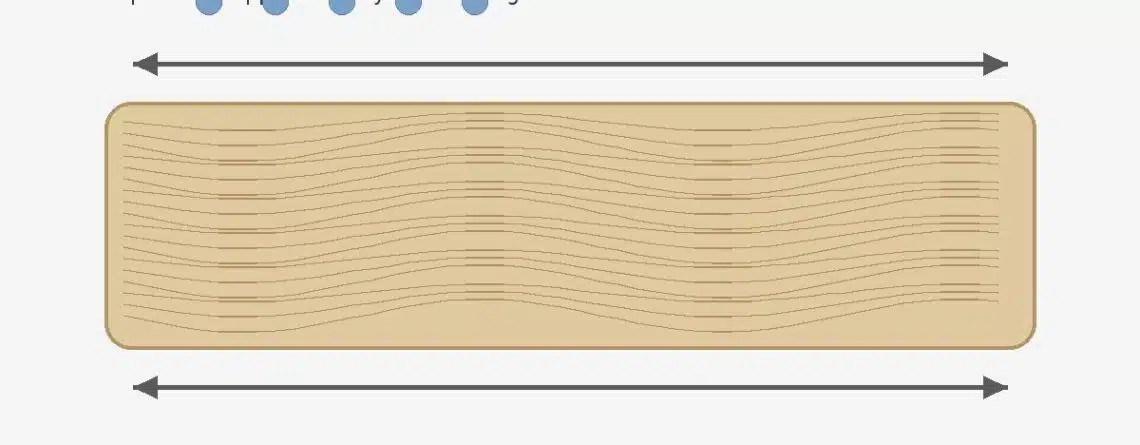
Inside every piece of wood are long tubular cells. When moisture enters those cells, they swell sideways. When moisture leaves, they shrink sideways. Movement happens:
-
Very little along the grain (lengthwise)
-
Significantly across the grain (width and thickness)
That is why tabletops widen in summer and hardwood floors gap in winter.
For a technical reference on wood–moisture relationships, see the U.S. Forest Products Laboratory:
https://www.fpl.fs.usda.gov/documnts/fplgtr/fplgtr190/chapter_04.pdf
What Causes Wood to Warp?
Warping happens when moisture changes unevenly within a board.
If one face absorbs moisture faster than the other — or one side dries more quickly — internal stress builds. The board relieves that stress by bending.
Common Types of Warp
-
Cupping – edges rise or center rises
-
Bowing – lengthwise curve
-
Twisting (wind) – corners are not on the same plane
-
Crooking – edgewise curve
Wood movement itself is normal. Problems arise when wood is restrained and not allowed to move naturally.
Moisture Content and Wood Acclimation
Why Wood Acclimation Matters
Proper wood acclimation allows lumber to adjust to the humidity level of the space where it will live. Before final milling, boards should rest in your shop so their moisture content stabilizes with the surrounding air.
Skipping acclimation often leads to:
-
Cupped panels after glue-up
-
Twisted boards after CNC carving
-
Cracks after installation
WOOD Magazine provides a helpful overview of moisture management:
https://www.woodmagazine.com/materials-guide/lumber/how-dry-is-your-wood
Why the Weight of the Water Matters
The amount of movement in any piece of wood is directly tied to the weight of the water held inside its structure. As wood dries and loses bound water, shrinkage occurs across the grain.
This is why wide boards show more noticeable movement than narrow ones. When moisture leaves unevenly, stress builds unevenly.
Different wood species behave differently:
-
Maple and oak show greater tangential movement
-
Walnut tends to be more dimensionally stable
-
Quarter-sawn boards move more predictably than flat-sawn boards
The Wood Database explains dimensional shrinkage here:
https://www.wood-database.com/wood-articles/dimensional-shrinkage/
How Much Does Wood Actually Move?
Movement depends on:
-
Wood species
-
Grain orientation
-
Width of the board
-
Moisture change range
A 12-inch-wide red oak board can change nearly 1/4 inch between dry winter air and humid summer air.
That’s not a defect — that’s physics.

At The Original Workshop, we account for this in every build. You can see examples of stable hardwood construction here:
https://theoriginalworkshop.com/product-category/games/cribbage-boards/
https://theoriginalworkshop.com/our-projects/end-grain-cutting-board/
How Growth Rings Influence Stability
The orientation of growth rings inside a board plays a major role in how it behaves over time.
When lumber is flat-sawn, the growth rings run in wide arcs across the face of the board.
As moisture levels change, those curved rings expand and shrink unevenly, which can encourage cupping.
In contrast, quarter-sawn lumber has growth rings that are more vertical in orientation.
This configuration promotes more balanced movement across the width of the board and often results in
minimal movement compared to flat-sawn material.
While no solid wood is completely immune to seasonal change, grain orientation can significantly reduce distortion.
Understanding how growth rings are positioned within a piece of wood allows woodworkers to predict how it may respond to humidity changes.
Boards with tighter, more consistent ring patterns often behave more predictably, especially in wide panels or tabletops.
How to Prevent Wood from Warping
1. Allow Proper Acclimation
Sticker boards and let air circulate evenly.
2. Mill Evenly
Remove small amounts from each face. Let boards rest. Re-mill if needed.
Fine Woodworking discusses working with stressed panels here:
https://www.finewoodworking.com/2009/05/01/working-with-warped-panels
3. Use a Moisture Meter
Ensure boards in a glue-up have similar moisture content.
4. Finish All Faces
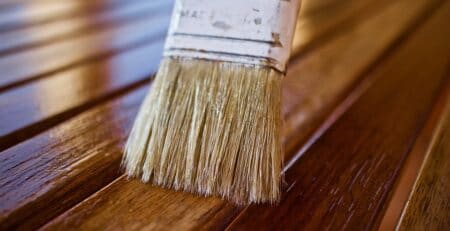
Finishing slows moisture exchange and keeps it balanced.
5. Design for Movement
Use elongated screw holes, figure-8 fasteners, Z-clips, or floating panels so seasonal movement does not cause cracking.
How to Fix Warped Wood
Not every warped board is ruined.
Mild Cupping
-
Allow moisture to rebalance
-
Clamp between straight cauls
-
Let it dry slowly
Severe Cupping
-
Rip into narrower strips
-
Joint edges flat
-
Re-glue
Twisting
-
Re-joint and plane if thickness allows
Sometimes, the best solution is redesigning the piece to accommodate movement instead of fighting it.

Storage Tips That Prevent Problems
-
Store lumber flat
-
Use stickers between layers
-
Keep weight evenly distributed
-
Avoid leaning boards vertically long term
-
Maintain consistent humidity
Stable storage prevents uneven moisture gain or loss.
Why Wood Movement Matters in CNC Work
CNC carving removes material, which changes stress distribution inside a board. Thin carved areas can move more quickly than thicker areas.
Before machining detailed wood products, we evaluate:
-
Grain orientation
-
Species stability
-
Moisture content in wood
-
Thickness ratios
This ensures dimensional stability in finished pieces.
See our CNC work here:
https://theoriginalworkshop.com/portfolioskills/cnc-projects/
Frequently Asked Questions
Why does wood expand and contract?
Wood absorbs and releases moisture from the surrounding air. As humidity rises, it swells. As humidity drops, it dries and shrinks — mostly across the grain.
Does wood expand and contract in length?
Very little. Most movement occurs across width and thickness.
What causes wood to warp?
Uneven moisture changes create internal stress, leading to cupping, bowing, twisting, or crooking.
Can warped wood be fixed?
Often yes. Mild warp may respond to moisture rebalancing and clamping. Severe warp may require re-milling or ripping and re-gluing.
Why is wood acclimation important?
Wood acclimation allows moisture content to stabilize before final construction, reducing unexpected movement later.
Final Thoughts
Wood movement is not a flaw — it is a natural response to environmental change. When moisture content in wood is understood and respected, dimensional change becomes predictable rather than destructive.
High-quality wood products are built with this in mind. By selecting appropriate wood species, allowing proper acclimation, and designing with movement allowance, projects remain stable through seasonal shifts.
If you’re considering a custom hardwood build crafted with long-term stability in mind, contact us here:
👉 https://theoriginalworkshop.com/contact-the-original-workshop/
When you respect the science behind wood movement, you build pieces that last for generations.
Frequently Asked Questions
Why does wood expand and contract?
Wood is hygroscopic, meaning it absorbs and releases moisture as humidity changes. When moisture increases, wood swells. When humidity drops, wood shrinks — mostly across the grain.
Does wood expand and contract in length?
Very little. Most movement happens across the grain (width and thickness), not along the length of the board.
What causes wood to warp?
Uneven moisture change causes internal stress. If one face dries or absorbs moisture faster than the other, the board may cup, bow, twist, or crook.
Can warped wood be fixed?
Often yes. Mild cupping can be corrected with acclimation and clamping. Severe warp may require re-milling or ripping and re-gluing.